
3D printers have become more affordable and accessible than ever, but many new users still wonder about one practical question: how much electricity does a 3D printer use?
The good news is that most consumer 3D printers are surprisingly energy efficient. While they can run for hours or even days at a time, their actual electricity costs are often much lower than people expect. Understanding power consumption can help you estimate operating costs, choose an efficient printer, and optimize your printing workflow.
In this guide, I’ll explain exactly how much electricity different types of 3D printers use, what factors affect energy consumption, how much typical prints cost to run, and ways to reduce power usage without sacrificing print quality.
Quick Answer: How Much Electricity Does a 3D Printer Use?
Most consumer FDM 3D printers use between 50 and 250 watts while actively printing.
On average:
| Printer Type | Average Power Usage |
|---|---|
| Small FDM Printer | 50–100 watts |
| Standard FDM Printer | 100–150 watts |
| Large FDM Printer | 150–300 watts |
| Enclosed FDM Printer | 150–400 watts |
| Resin Printer | 30–100 watts |
For a typical desktop FDM printer running an 8-hour print, electricity consumption usually falls between 0.8 and 1.5 kilowatt-hours (kWh).
At an electricity rate of $0.15 per kWh, that translates to roughly $0.12 to $0.23 per print.
In many cases, the filament costs significantly more than the electricity used to print the object.
Understanding Watts, Kilowatts, and Electricity Costs
Before calculating costs, it helps to understand a few basic terms.
Watts (W)
Watts measure the amount of power a device consumes at a given moment.
For example:
- Printer idle: 5–15 watts
- Heated bed warming up: 250–500 watts
- Active printing: 80–200 watts
Kilowatt-Hours (kWh)
Utility companies charge based on kilowatt-hours.
One kilowatt-hour equals:
- 1,000 watts used for 1 hour
- 100 watts used for 10 hours
- 200 watts used for 5 hours
Electricity Cost Formula
The basic formula is:
Cost = Power (kW) × Time (Hours) × Electricity Rate
For example:
A printer using 120 watts for 10 hours:
120W = 0.12kW
0.12 × 10 × $0.15 = $0.18
That print would cost approximately 18 cents in electricity.
How Much Electricity Does an FDM 3D Printer Use?
FDM printers are the most common type of consumer 3D printer.
They use electricity primarily for:
- Heating the nozzle
- Heating the build plate
- Running stepper motors
- Cooling fans
- Control electronics
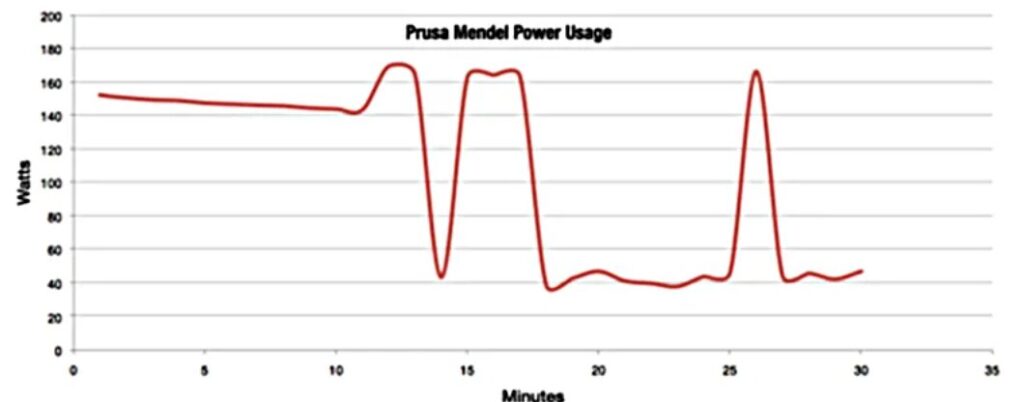
The heated bed is usually the largest power consumer.
During Warm-Up
When a print first starts, the printer draws the most power.
Typical power draw:
- Hotend heating: 30–60 watts
- Heated bed: 100–400 watts
- Total startup load: 150–500 watts
The warm-up phase generally lasts only a few minutes.
During Printing
After reaching target temperature, power usage drops because heaters cycle on and off.
Average power consumption:
- PLA printing: 80–150 watts
- PETG printing: 100–180 watts
- ABS printing: 120–250 watts
Higher-temperature materials require more energy.
How Much Electricity Does a Resin Printer Use?
Resin printers generally consume less electricity than FDM printers.
Unlike filament printers, they do not maintain a heated build plate throughout the print.
Power usage typically comes from:
- UV light source
- LCD screen
- Motors
- Control board
Average resin printer consumption:
- Small resin printer: 30–60 watts
- Mid-size resin printer: 50–80 watts
- Large resin printer: 80–120 watts
For many users, resin printing costs only a few cents per print in electricity.
Electricity Usage by Popular Print Sizes
Small Print
Examples:
- Miniatures
- Phone stands
- Small organizers
Typical print time:
- 2–4 hours
Electricity usage:
- 0.2–0.6 kWh
Cost:
- $0.03–$0.09
Medium Print
Examples:
- Functional parts
- Storage containers
- Tool holders
Typical print time:
- 6–12 hours
Electricity usage:
- 0.8–1.8 kWh
Cost:
- $0.12–$0.27
Large Print
Examples:
- Cosplay props
- Helmets
- Large models
Typical print time:
- 20–50 hours
Electricity usage:
- 2–8 kWh
Cost:
- $0.30–$1.20
Even large prints are generally inexpensive from an electricity standpoint.
What Parts of a 3D Printer Use the Most Power?
Heated Bed
The heated bed is usually the biggest energy consumer.
Power ratings often range from:
- 120 watts
- 220 watts
- 350 watts
- 500 watts
Larger build volumes require larger heated beds, which increases electricity consumption.
Hotend
The hotend uses comparatively little power.
Most hotends consume:
- 30–60 watts
Once temperature stabilizes, actual average usage is lower.
Stepper Motors
Motors move:
- X-axis
- Y-axis
- Z-axis
- Extruder
Combined motor consumption typically ranges from:
- 10–40 watts
Fans and Electronics
Control boards, displays, and cooling fans use relatively little power.
Combined usage is usually:
- 5–20 watts
Does Filament Type Affect Electricity Usage?
Yes.
Different materials require different temperatures.
PLA
Typical temperatures:
- Nozzle: 190–220°C
- Bed: 0–60°C
Lowest energy consumption among common materials.
PETG
Typical temperatures:
- Nozzle: 220–250°C
- Bed: 70–90°C
Moderate energy usage.
ABS
Typical temperatures:
- Nozzle: 230–260°C
- Bed: 90–110°C
Higher energy consumption.
Nylon
Typical temperatures:
- Nozzle: 240–300°C
- Bed: 70–110°C
Among the most energy-intensive consumer materials.
How Much Does a 3D Printer Cost to Run Per Month?
Let’s look at a realistic example.
Assume:
- Average power draw: 120 watts
- Printing time: 4 hours per day
- Electricity rate: $0.15/kWh
Calculation:
0.12 × 4 × 30 = 14.4 kWh
Monthly cost:
14.4 × $0.15 = $2.16
Even doubling print time would keep electricity costs relatively low.
Hobby User
- 20–40 printing hours monthly
- Approximately $1–$5 per month
Enthusiast User
- 100–200 printing hours monthly
- Approximately $5–$15 per month
Small Business User
- 300–700 printing hours monthly
- Approximately $20–$80 per month
Do Enclosures Increase Electricity Usage?
Sometimes.
An enclosure can increase energy consumption slightly if it includes:
- Additional heaters
- Circulation fans
- Temperature control systems
However, enclosed printers often maintain temperatures more efficiently.
In some cases, an enclosure can actually reduce overall energy use by helping the heated bed and hotend retain heat.
How to Measure Your Printer’s Actual Power Usage
The most accurate method is using a power meter.
Popular options include:
- Kill A Watt meters
- Smart plugs with energy monitoring
- Home energy monitors
These devices plug between the wall outlet and the printer.
They track:
- Real-time wattage
- Total kWh consumed
- Estimated operating costs
This provides much more accurate data than relying on manufacturer specifications.
Ways to Reduce 3D Printer Electricity Consumption
Lower Bed Temperature When Possible
Many PLA filaments print successfully at lower bed temperatures.
Reducing bed temperature can noticeably lower power usage.
Improve Insulation
Adding insulation beneath the heated bed can reduce heat loss and improve efficiency.
Print Multiple Parts at Once
Combining several parts into one print often uses less energy than running separate print jobs.
Use Efficient Print Settings
Optimized settings can reduce print time without sacrificing quality.
Examples include:
- Larger nozzle sizes
- Adaptive layer heights
- Optimized infill patterns
Keep the Printer in a Warm Room
Cold environments force heaters to work harder.
A stable room temperature improves efficiency.
Is a 3D Printer Expensive to Run?
For most hobbyists, no.
Compared to many household appliances, 3D printers are relatively inexpensive to operate.
For perspective:
| Device | Typical Power Usage |
|---|---|
| Gaming PC | 300–700 watts |
| Space Heater | 1,500 watts |
| Microwave | 800–1,500 watts |
| Refrigerator | 100–800 watts |
| Typical FDM Printer | 100–150 watts |
A 3D printer generally consumes less electricity than many devices people use every day.
Frequently Asked Questions
Does a 3D printer use electricity when idle?
Yes, but very little.
Most printers consume between 5 and 15 watts while powered on but not printing.
Do larger printers use more electricity?
Generally yes.
Larger printers often have:
- Bigger heated beds
- More powerful heaters
- Longer print times
All of which increase energy consumption.
Is resin printing cheaper than FDM printing?
In terms of electricity usage, resin printers are often more efficient.
However, resin materials typically cost more than standard PLA filament.
What uses more electricity: filament or resin printers?
Most FDM printers use more electricity because they continuously heat both the nozzle and build plate.
Can solar power run a 3D printer?
Yes.
Many consumer 3D printers have low enough power requirements to operate from properly sized solar and battery systems.
Final Thoughts
If you’re worried about electricity costs, a 3D printer is unlikely to have a major impact on your utility bill. Most consumer printers use between 50 and 250 watts during operation, and even long prints often cost only a few cents in electricity.
The biggest factors affecting power consumption are print duration, bed temperature, printer size, and material choice. Heated beds account for the majority of energy use, while motors and electronics consume relatively little power.
For most hobbyists, filament costs will far exceed electricity costs over the life of the printer. Understanding your printer’s energy usage can still help you optimize efficiency, estimate operating expenses, and make informed purchasing decisions when comparing different machines.