
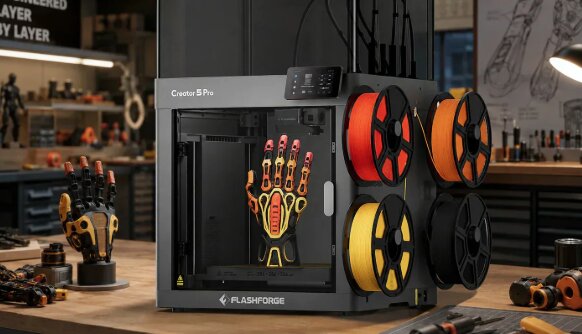
Small businesses are increasingly turning to 3D printing to produce prototypes, custom products, replacement parts, promotional items, and even finished products for customers. Whether you’re running an Etsy store, a product design company, a cosplay business, or a local manufacturing operation, the right 3D printer can significantly improve production speed while reducing outsourcing costs.
However, not every 3D printer is suitable for business use.
A small business printer needs to be reliable, easy to maintain, capable of producing consistent results, and fast enough to handle regular production workloads. Downtime, failed prints, and excessive calibration can quickly eat into profits.
After comparing print quality, reliability, automation, multi-color capabilities, material compatibility, speed, ease of use, and overall value, one machine stood out as the strongest option for most small business owners.
Our Top Choice: Anycubic Kobra S1C
Why We Recommend It
The Anycubic Kobra S1C delivers an exceptional balance of speed, automation, reliability, and business-friendly features.
Its fully enclosed CoreXY design, built-in filament drying system, automatic calibration, multi-color printing capabilities, and impressive 600mm/s print speeds make it one of the most complete production-focused printers currently available.
Unlike many competing machines, it also minimizes common causes of print failures through intelligent filament management and automated calibration systems, helping businesses spend less time troubleshooting and more time producing products.
For small business owners looking for the best combination of performance, reliability, and value, the Kobra S1C is currently our top choice.
Best 3D Printers for Small Business: Our Top Picks
1. Anycubic Kobra S1C – Best Overall 3D Printer for Small Business
Pros
✓ Built-in active filament drying system
✓ Extremely fast 600mm/s CoreXY printing
✓ Fully enclosed chamber
✓ Automatic calibration and leveling
✓ Supports multi-color printing
✓ Smart app and LAN control
✓ Excellent for production environments
Cons
✕ Additional ACE units required for expanded color capability
✕ Larger footprint than entry-level printers
Specifications
| Feature | Specification |
|---|---|
| Print Speed | Up to 600mm/s |
| Motion System | CoreXY |
| Enclosure | Fully Enclosed |
| Auto Leveling | Yes |
| Multi-Color Printing | Up to 8 colors with additional ACE units |
| Filament Drying | Built-in Active Drying |
| Remote Monitoring | App and LAN Control |
| Calibration | Fully Automatic |
When evaluating printers for business use, reliability is often more important than raw specifications.
The Anycubic Kobra S1C excels because it addresses many of the issues that commonly disrupt production workflows.
One of its most valuable features is the integrated filament drying system. Moisture is a major cause of failed prints, poor layer adhesion, bubbling, and nozzle clogs. For hobbyists this may be a minor inconvenience. For businesses producing products daily, it can lead to wasted material and lost revenue.
The Kobra S1C actively manages filament conditions throughout the printing process, helping maintain consistent print quality during lengthy production runs.
The printer’s CoreXY architecture allows it to achieve speeds of up to 600mm/s while maintaining excellent precision. This can significantly reduce production times compared to older Cartesian-style printers.
The fully enclosed design further enhances reliability. Materials such as ABS often benefit from stable chamber temperatures, reducing warping and improving print consistency.
Another major advantage is automation.
The one-click auto-leveling system, vibration compensation, and flow rate calibration dramatically reduce setup time. Small business owners can focus on fulfilling orders instead of constantly adjusting machine settings.
Multi-color capability also creates additional revenue opportunities. Businesses producing custom products, decorative items, cosplay props, branded merchandise, and promotional products can create more visually appealing products without requiring manual assembly or painting.
Remote monitoring through the Anycubic ecosystem allows users to manage production more efficiently, especially when running multiple printers.
For businesses seeking a dependable production machine that minimizes maintenance while maximizing output, the Kobra S1C offers one of the strongest overall packages available.
2. Bambu Lab P1S Combo – Best Professional Multi-Color Production Printer
Pros
✓ Supports up to 16 colors
✓ Fast 500mm/s printing
✓ Excellent print quality
✓ Proven AMS ecosystem
✓ Fully enclosed design
✓ Auto bed leveling
✓ Quick setup process
Cons
✕ AMS system adds complexity
✕ Higher material waste during color changes
Specifications
| Feature | Specification |
|---|---|
| Print Speed | Up to 500mm/s |
| Motion System | CoreXY |
| Enclosure | Fully Enclosed |
| Auto Leveling | Yes |
| Multi-Color Printing | Up to 16 Colors |
| Setup Time | Approximately 15 Minutes |
| Material Support | PLA, PETG, ABS, ASA, TPU, PA, PC |
Bambu Lab has rapidly established itself as one of the most respected names in desktop 3D printing.
The P1S Combo demonstrates why.
For businesses focused on multi-color production, few machines currently rival its capabilities.
The included AMS system enables sophisticated multi-color and multi-material workflows that would be extremely difficult to achieve manually.
This capability opens opportunities for businesses producing:
- Product prototypes
- Educational models
- Cosplay accessories
- Custom gifts
- Branded merchandise
- Decorative products
The P1S also offers impressive production speed.
Its 500mm/s CoreXY system enables rapid turnaround times while maintaining excellent dimensional accuracy and surface quality.
One area where the P1S particularly shines is user experience.
Setup is straightforward, and automatic bed leveling reduces the learning curve significantly. Small business owners without extensive technical experience can begin producing products relatively quickly.
The enclosed chamber also improves performance when working with more demanding engineering materials.
For companies planning to offer highly customized products, the P1S Combo remains one of the strongest options on the market.
3. ELEGOO Centauri Carbon – Best 3D Printer for Engineering and Functional Parts
Pros
✓ Supports carbon fiber reinforced materials
✓ High-temperature 320°C nozzle
✓ Built-in monitoring camera
✓ Die-cast aluminum frame
✓ Excellent structural rigidity
✓ Fully assembled out of the box
Cons
✕ Less focused on multi-color production
✕ Advanced materials may increase operating costs
Specifications
| Feature | Specification |
|---|---|
| Print Speed | Up to 500mm/s |
| Build Volume | 256 x 256 x 256 mm |
| Nozzle Temperature | Up to 320°C |
| Frame | Die-Cast Aluminum |
| Camera | Built-In |
| Auto Calibration | Yes |
| Material Support | Carbon Fiber Reinforced Filaments and More |
Not every small business is producing decorative products.
Many businesses require functional parts, engineering prototypes, fixtures, jigs, and performance-oriented components.
This is where the ELEGOO Centauri Carbon excels.
Its 320°C hardened nozzle allows it to process more demanding materials than many standard consumer printers.
Businesses involved in:
- Product development
- Drone manufacturing
- Automotive projects
- Engineering consulting
- Robotics
- Custom fabrication
can particularly benefit from its expanded material capabilities.
The integrated die-cast frame provides exceptional rigidity, helping maintain dimensional accuracy during high-speed operation.
Built-in monitoring features also simplify print management.
The chamber camera allows operators to monitor jobs remotely and quickly identify issues before they become costly failures.
For businesses focused on functional parts rather than decorative multi-color products, the Centauri Carbon represents outstanding value.
4. Bambu Lab A1 Combo – Best Value 3D Printer for Small Business
Pros
✓ Excellent value
✓ Full-auto calibration
✓ Multi-color printing support
✓ Quiet operation
✓ Easy maintenance
✓ User-friendly ecosystem
Cons
✕ Open-frame design
✕ Less suitable for some advanced materials
Specifications
| Feature | Specification |
|---|---|
| Multi-Color Printing | Yes |
| Auto Calibration | Full Automatic |
| Noise Level | ≤48 dB |
| Flow Compensation | Active |
| Nozzle System | Quick-Swap |
| AMS Lite Support | Included |
Not every small business needs an industrial-style printer.
Many entrepreneurs start with Etsy shops, personalized gift businesses, local craft sales, and custom product operations.
For these users, affordability and ease of use often matter more than maximum material compatibility.
The Bambu Lab A1 Combo delivers one of the most beginner-friendly experiences currently available.
Its fully automated calibration system dramatically reduces setup complexity.
Even users with limited technical experience can begin producing professional-quality prints quickly.
The AMS Lite system enables reliable multi-color printing, opening opportunities for custom products and personalized merchandise.
Another major advantage is noise control.
Operating at under 48 dB, the A1 is significantly quieter than many competing printers. This can be particularly beneficial for home-based businesses operating from offices, workshops, or spare rooms.
Its active flow compensation system also helps maintain consistent print quality without requiring extensive tuning.
For entrepreneurs launching their first 3D printing business, the A1 Combo offers an excellent balance of affordability, simplicity, and capability.
Product Comparison Table
| Printer | Print Speed | Enclosed | Multi-Color | Auto Calibration | Best For |
|---|---|---|---|---|---|
| Anycubic Kobra S1C | 600mm/s | Yes | Yes | Yes | Overall business use |
| Bambu Lab P1S Combo | 500mm/s | Yes | Up to 16 colors | Yes | Multi-color production |
| ELEGOO Centauri Carbon | 500mm/s | Yes | No | Yes | Engineering parts |
| Bambu Lab A1 Combo | High Speed | No | Yes | Yes | Value and beginners |
What Small Businesses Should Look For in a 3D Printer
Many business owners make the mistake of purchasing a printer based solely on price.
In reality, the cheapest machine often becomes the most expensive over time due to failed prints, maintenance requirements, and lost productivity.
Here are the most important factors to consider.
Reliability
Every failed print costs time and material.
Reliable printers with automated calibration systems often provide a better return on investment than cheaper machines that require constant adjustments.
Print Speed
Faster production means more products completed each day.
Modern CoreXY printers such as the Kobra S1C, P1S, and Centauri Carbon dramatically outperform older generation machines.
Material Compatibility
Different businesses require different materials.
PLA works well for decorative products.
ABS, ASA, nylon, and carbon fiber composites are often better suited for engineering applications.
Automation
Features such as:
- Auto bed leveling
- Flow calibration
- Vibration compensation
- Filament monitoring
can significantly reduce operational headaches.
Multi-Color Capability
Businesses selling customized products often benefit from multi-color printing.
This can eliminate painting and assembly steps while increasing perceived product value.
Best Types of Small Businesses for 3D Printing
Modern 3D printers support a wide variety of business models.
Some of the most popular include:
Etsy Shops
Custom gifts, organizers, toys, signs, and personalized products remain some of the most successful categories.
Product Prototyping
Designers and inventors can create prototypes in-house rather than outsourcing development.
Cosplay Businesses
Multi-color printers are particularly useful for cosplay accessories and prop production.
Engineering Services
Functional parts, jigs, fixtures, and prototypes represent lucrative opportunities.
Educational Products
Teachers and educational businesses increasingly utilize 3D printing to create custom learning materials.
Local Manufacturing
Small-batch manufacturing is becoming increasingly practical with modern high-speed printers.
Frequently Asked Questions
What is the best 3D printer for a small business?
The Anycubic Kobra S1C is our top recommendation because it combines high-speed production, built-in filament drying, automatic calibration, multi-color printing capabilities, and a fully enclosed design.
Is 3D printing profitable for small businesses?
Yes. Many businesses successfully generate revenue through custom products, prototypes, replacement parts, educational models, and print-on-demand services. Profitability depends on product selection, pricing strategy, and production efficiency.
Should I buy an enclosed 3D printer for business use?
In most cases, yes. Enclosed printers provide more stable printing conditions, better material compatibility, and improved reliability during long production runs.
Is multi-color printing worth it?
For businesses producing consumer-facing products, multi-color printing can increase product appeal and reduce post-processing labor.
How fast should a business 3D printer be?
Modern production-oriented printers typically operate between 300mm/s and 600mm/s. Faster speeds allow businesses to complete more orders while maintaining profitability.
What materials are best for small business production?
PLA remains the most popular due to ease of use and low cost. Businesses requiring stronger parts often use PETG, ABS, ASA, nylon, or carbon fiber reinforced materials.
Can a home-based business use these printers?
Absolutely. Many Etsy sellers, product designers, and entrepreneurs operate successful businesses using desktop 3D printers from home workshops or dedicated office spaces.
Final Verdict
Choosing the best 3D printer for small business ultimately comes down to balancing reliability, speed, automation, material compatibility, and long-term productivity.
After comparing all four options, the Anycubic Kobra S1C earns our top recommendation. Its combination of 600mm/s CoreXY performance, built-in filament drying, automatic calibration, enclosed chamber, multi-color capabilities, and smart remote management creates a business-focused package that minimizes downtime while maximizing output.
The Bambu Lab P1S Combo remains an outstanding choice for businesses heavily focused on multi-color products and custom merchandise. The ELEGOO Centauri Carbon excels for engineering applications requiring advanced materials and functional components. Meanwhile, the Bambu Lab A1 Combo offers tremendous value for entrepreneurs launching their first 3D printing business.
For most small business owners, however, the Anycubic Kobra S1C offers the strongest blend of production efficiency, ease of use, reliability, and future growth potential, making it our top choice for the best 3D printer for small business in 2026.
Our Final Rankings
- Anycubic Kobra S1C – Best Overall 3D Printer for Small Business
- Bambu Lab P1S Combo – Best Multi-Color Production Printer
- ELEGOO Centauri Carbon – Best for Engineering and Functional Parts
- Bambu Lab A1 Combo – Best Value Option for New Businesses
For businesses that depend on consistent production and reliable results, the Anycubic Kobra S1C delivers the most complete package and is the printer we would choose for the majority of small business applications.